The 3 Listening Zones: How They Guide Customized Tomatis® Programs at The Listening Lab
At The Listening Lab in St. Louis, I specialize in the Tomatis® Method—a neurosensory approach that harnesses the power of sound to enhance brain function, emotional balance, and overall well-being. Central to this method are the 3 Listening Zones, a framework developed by Dr. Alfred Tomatis that divides the auditory spectrum into overlapping frequency bands. Each zone influences specific aspects of our physical, cognitive, and energetic systems. As certified Tomatis® practitioners and consultants, understanding these zones allows us to craft highly personalized programs tailored to each client's unique needs—whether they're struggling with attention issues, learning challenges, emotional regulation, or simply seeking peak performance.
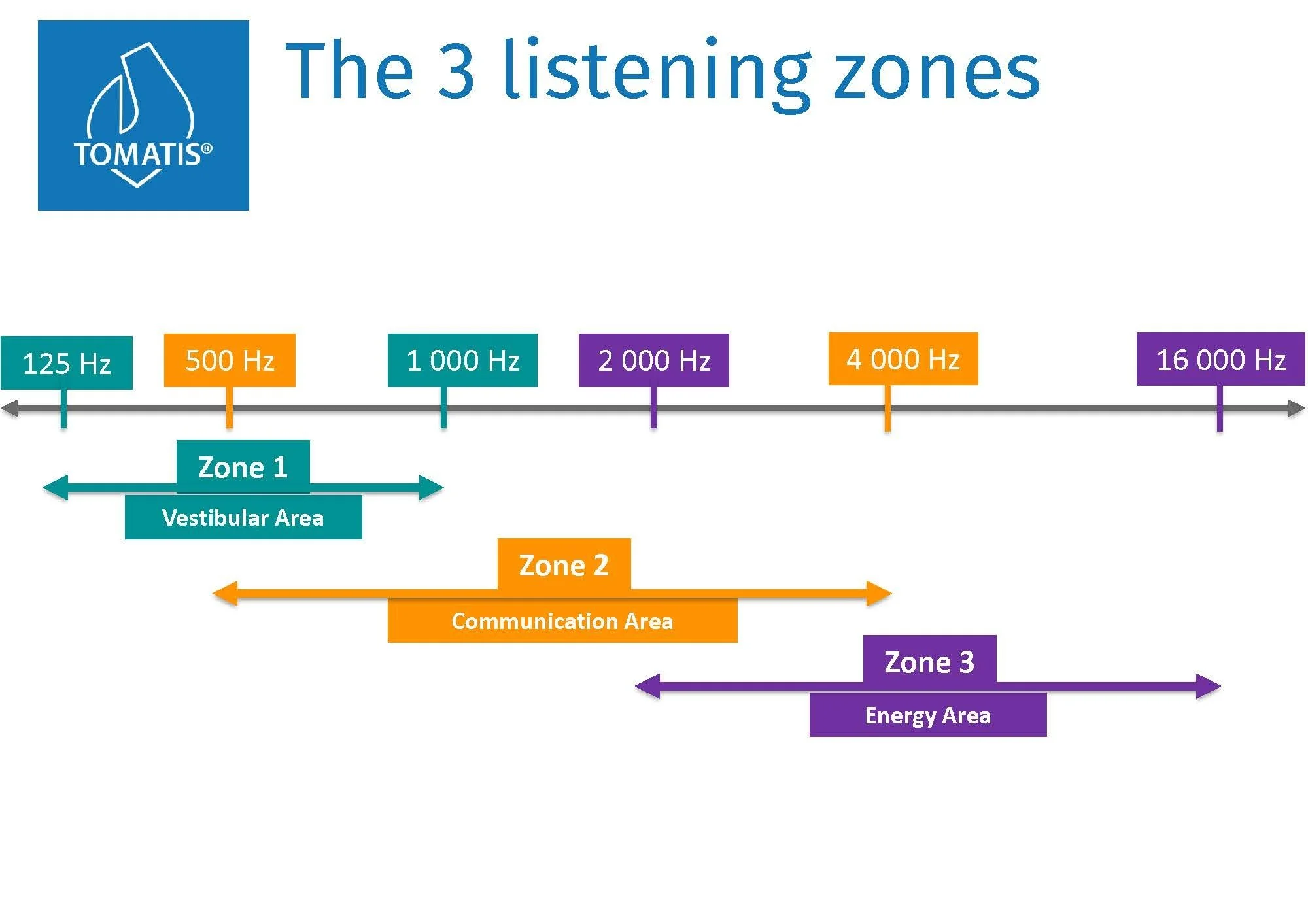
The ZONES
The 3 Listening Zones: A Breakdown
Human hearing spans roughly 125 Hz to 16,000 Hz, and the Tomatis® Method maps this range into three interconnected zones. They overlap, meaning stimulation in one can positively ripple into others, creating a holistic effect. Here's a quick overview:
Zone 1: Vestibular Area (125–1,000 Hz)
This foundational zone is all about body awareness and grounding. It supports posture, balance, spatial orientation, coordination, rhythm, praxis (motor planning), emotional regulation, socialization, memory, attention, and motivation.
Why it matters for customization: If a client shows signs of vestibular challenges—like poor balance, anxiety in social settings, or difficulty with focus—we prioritize low-frequency stimulation to build a stable base. For example, children with sensory processing issues or adults recovering from stress often start here to foster security and readiness for higher functions.Zone 2: Communication Area (500–4,000 Hz)
The heart of language and connection, this mid-range zone drives phonemic awareness, musical analysis, verbal discrimination and precision, working memory, selective attention, thought formalization, and verbal communication skills.
Why it matters for customization: Many clients come to us with communication hurdles, such as auditory processing disorders, speech delays, or reading difficulties. By assessing sensitivities in this zone through our initial listening tests, we filter music to sharpen these skills—helping educators, professionals, or families improve clarity and engagement in daily interactions.Zone 3: Energy Area (2,000–16,000 Hz)
High frequencies act as "fuel" for the brain, promoting cortical awakening, attentional processes, creativity, refined analysis (building on Zone 2), and voice quality (timbre).
Why it matters for customization: This zone is key for boosting vitality and overcoming fatigue or creative blocks. For clients with ADHD, low energy, or those in high-demand fields like music or public speaking, we emphasize high-frequency enrichment to "charge" the system, enhancing overall dynamism and expressiveness.
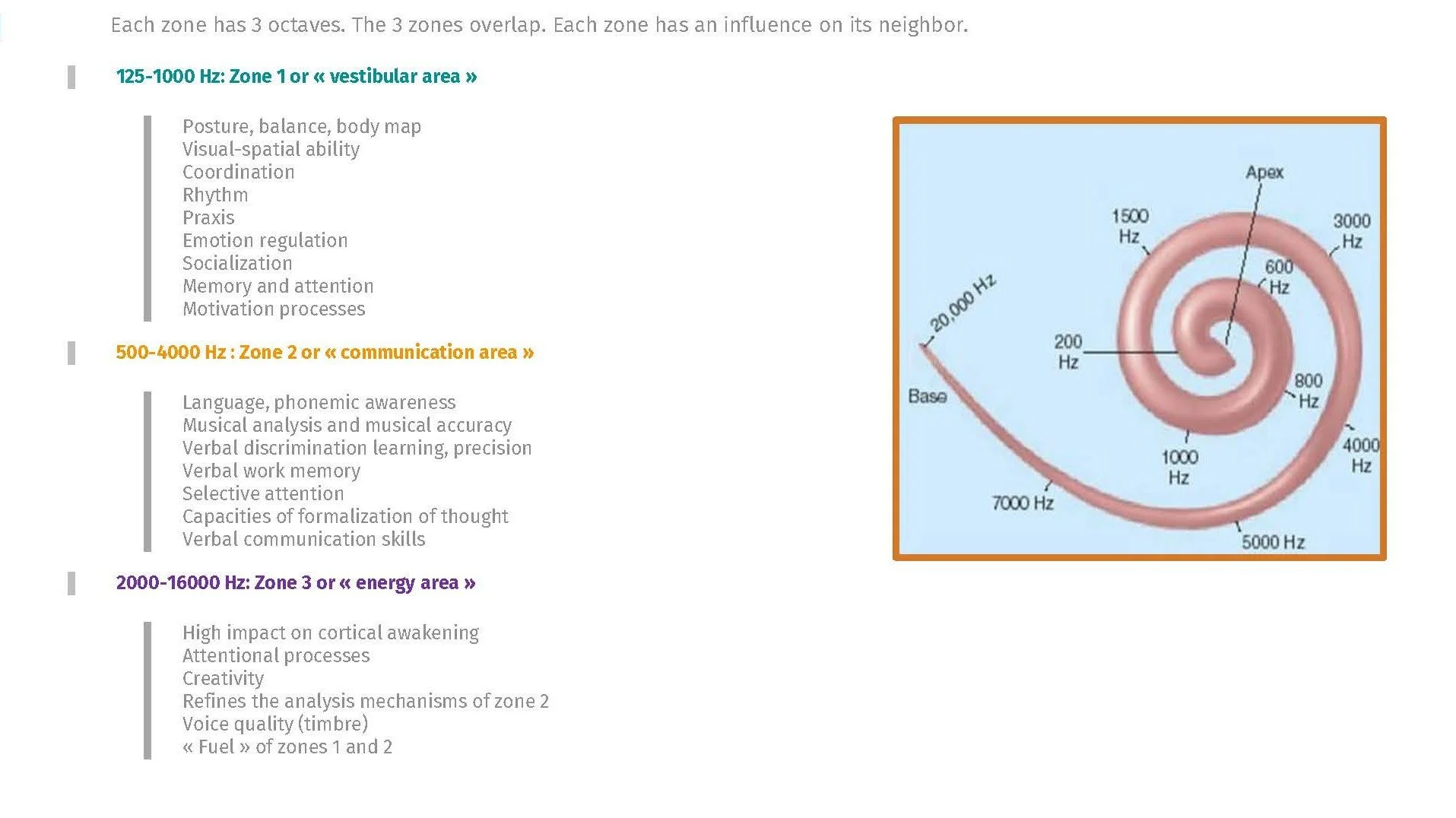
The zones in relation to the cochlea, located in the inner ear.
These zones aren't isolated; they form a dynamic ecosystem, much like the cochlea's spiral structure where low frequencies anchor at the base and highs energize from the apex. The Tomatis® Method uses specially filtered music (often Mozart or Gregorian chants) delivered via bone and air conduction headphones to target these areas.
How I Customize Programs
As a Level 2 Tomatis® practioner at The Listening Lab, customization begins with a comprehensive assessment. First, I will email you a TEQ (Tomatis Evaluation Questionnaire) for FREE. This 140 sliding scale questionnaire allows me to see which zones need work in relation to the others. If needed, I will conduct a listening test that maps your auditory profile—identifying hypersensitivities, hyposensitivities, or imbalances across the zones. This isn't just about hearing; it's about listening—the active process of perceiving and integrating sound.
Based on the results:
For learning and attention challenges: We might focus on Zone 2 to refine phonemic processing, while bolstering Zone 1 for better focus and Zone 3 for sustained energy.
For emotional regulation: Starting with Zone 1 to stabilize emotions, then layering in Zone 2 for better self-expression.
For motor or coordination issues: Heavy emphasis on Zone 1, with progressive integration of higher zones.
Programs are phased: initial "passive" listening sessions (80-120 hours total, spread over months) use gated, filtered music to gently retrain the ear-brain connection. We adjust parameters like filtering intensity, bone conduction emphasis. Follow-ups include progress checks, ensuring adaptations as clients evolve. The beauty? It's non-invasive, suitable for all ages, and flexible—many complete sessions at home. I've seen transformative results: kids gaining confidence in school, adults reducing stress, and performers unlocking creativity.
The 3 Listening Zones go beyond one-size-fits-all solutions, creating programs that address root causes through sound.
If you're curious how this could benefit you or a loved one, visit www.listeninglabstl.com to schedule a consultation. For more on the science, check out www.tomatis.com.
Let's tune into your potential!